This revelation is the success of a man
- Ascribe

- Jun 19, 2023
- 11 min read
Updated: May 14
I am always thankful for Your kindness – You do not pressure for performance but encourage always for us to be together under any circumstance. I don’t know if our relationship is as all relationships with You should be – sometimes I get the sense that ours is at a beginning level, and maybe has been for all these years.
I wonder if there is more depth to be discovered or if where we are is where we have always wanted to be – that it is sufficient as it is. But then I realize there is much more – places unknown, thoughts unexpressed, desires unmet. Yet in all it seems to me that there is a level of response from You that remains the same, under any circumstance in my life.
Is this what our relationship is to be? I’m not complaining – I would give all to be in this place with You. Is there contentment for You too? Do you wish I would seek for more? Is there more You would wish to do through me? Do You see the lack of my enthusiasm for the greater, the deeper, the challenge of a life in You unfulfilled, and wish I would be consistent in seeking for more?
Or are these just my thoughts of guilt, for the lack of the pursuit of depth, of commitment, of dogged persistence in the face of all for everything You would want to do through my life? Sometimes I think the greater will not happen because I do not have the greater dedication or ambition.

You judge our relationship as you judge all of life. You see the great accomplishments of men, their dedication of pursuit in the face of great odds against success, their depth of commitment to their craft. And you measure your success in life, or lack thereof, against what you see in theirs, believing this is what life is to look like.
Even in spiritual matters you judge the same. Is this the truth? You believe that if all men were to move as you that nothing much would be gained, or accomplished – no discoveries, no progress, no overcoming. As you see you believe.
You have desired to be with Me, and have gained much within your heart as that has happened, yet feel it insufficient – that I would expect more from you for having come this far with Me. Men move in their desires – have you not done the same? Men seek accomplishment – have you not succeeded in the same way? Men seek for the prosperity of their souls as they seek for the progress of all men – have you not sought the same? Is not a walk with Me the apex of all the desires of man – and you are there?
Do not belittle our relationship, for I have sacrificed all that it might be just as it is; it is never about accomplishment, of success, of a contentment of heart for a job well done. No, it is always to be about this – this place of meeting, this oneness of heart, this growth of spirit, this revelation of the kingdom among men. In this revelation is the success of a man, not in what he does, but in what has been done for him. This place, this oneness, is what I have sought for him, sacrificed for him, that I might give it to him.
Most men seek otherwise, with seeming success, with greatness seen in the eyes of others. Yet, I have seen your heart, and the greatness therein, of the sacrifice and desire to be with Me – I would see you accomplish nothing else. Yet in that one thing is the release of all things you would desire to accomplish.
You are impatient, and that is good, for you know the potential of our relationship. Yet I cherish this moment, perhaps a moment of nothing appearing to happen, at least in your eyes – but in Mine all things of My heart for this moment are released because of your desire to be here above all else. You do not see the full potential of this moment, but in due time, you shall.
And then you will be grateful of the sacrifice of your heart, your time, your desire for Me. And in return I shall give all of Me to you, as I have from the very beginning.
∞
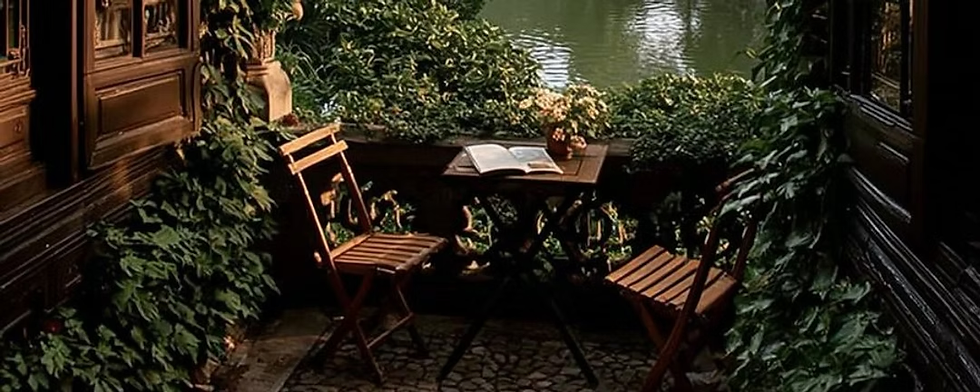
What You Are
His name was James Hartley, and he had run the same bookshop for thirty years.
He had chosen the space carefully — a narrow storefront on a side street, between a tailor and a pharmacy that had since become a nail salon — and he had filled it slowly, shelf by shelf, with the kinds of books that people did not know they needed until they held them. Old novels with worn spines. Volumes of essays. Anthologies of letters between people who had once meant everything to one another.
He had read every one.
And in thirty years, he had not written a word of his own.
This was the thing that lived in him — quiet, persistent, the way a stone lives at the bottom of a river. He was surrounded, every day, by the work of men and women who had given everything to their craft. He read their biographies as readily as their books. He knew how they had lived — in poverty, in exile, in relentless pursuit of the sentence that would not come — and he measured himself against them with a faithfulness he reserved for nothing else.
He had tried, once, to write. There was a notebook still, half-filled, in the bottom drawer of his desk. He had not opened it in twenty years. Not because the desire had left him.
Because the comparison had overtaken it.
Who was he, against all of this?

He opened the shop at seven each morning and closed it at six each evening, and in between he helped people find what they were looking for — and sometimes what they were not looking for — and he did this so naturally that most of his customers did not realize how precisely he had seen them. The woman whose husband had died that March, who stood too long before the philosophy section without touching anything, who needed not an argument but a companion. He found her one. The young man who came in angry and restless, looking for something to confirm the grievance he had been nursing, who needed instead to be surprised by a larger life. He found him one too.
He did this every day.
He did not count it.
— ❖ —
Among his regulars was a woman named Eleanor.
She had been coming to the shop every Saturday morning for as long as James could accurately remember — at least twenty years, possibly more. She was a retired professor of literature, which he had learned over time in the way you learn things about someone who is always present in a room you share, and she arrived precisely at nine, hung her coat on the hook by the door, settled into the leather armchair in the far corner, and read until noon.
She almost never bought anything.
At first James had found this mildly strange. But over time he had come to understand that the shop was something to Eleanor that it was not to anyone else — not a store but a room, not a transaction but a return. She came the way certain people visit a garden: not to take anything, but to be in a place that was already doing something to them simply by existing.
They spoke occasionally, briefly, warmly. She had recommended a few books to him over the years, and he had recommended a dozen to her. Mostly they left each other in peace.
James did not know what Eleanor did with her Saturdays between noon and the next Saturday morning. He had not thought to ask.
— ❖ —
One Saturday in early spring, she did not come.
James noticed at ten o’clock and thought nothing of it. He noticed again at eleven and told himself there could be a hundred explanations. At noon, when the armchair was still empty, he felt something he could not name — not alarm, not yet, but a kind of displacement, the way a room feels when a piece of furniture has been moved in the night.
He learned through a mutual acquaintance that Eleanor was in the hospital. That she had been admitted three weeks before. That she was not expected to return home.
He drove to see her on a Tuesday.
— ❖ —
She was smaller than he remembered.
Not frail — Eleanor had never been frail, and whatever was happening to her body had not yet reached her eyes — but smaller, as if the room required less of her than the shop had. She seemed glad to see him.
They talked for a few minutes about things of no particular importance: a book he had found last week that she would have wanted, the price of parking, the particular quality of afternoon light through the window. And then she said, with the directness that had always been her most notable characteristic:
“You have always wanted to write.”
It was not a question. James considered deflecting, then decided against it.
“Yes,” he said. “I have.”
“And you never have.”
She said it gently. It was not an accusation.
“No.”
“Because you compared yourself to the people on your shelves.”
He looked at his hands. “Something like that,” he said.
Eleanor was quiet for a moment. When she spoke again, she had turned toward the window, as if what she was about to say was for the light as much as for him.
“Do you remember a woman who came in about six years ago?” she said. “In a gray coat. She had lost her husband.”
“Margaret,” he said. “She still comes in.”
“What did you give her?”
He thought about it. “Chekhov. And a book of Wendell Berry’s essays.”
“She told me once,” Eleanor said, “that she did not know, when she walked into your shop that day, whether she was going to keep going. She told me something changed for her — not because of the books, exactly. Because someone had looked at her and known what she needed without her having to say it. She said it was the first time she had felt seen in months."
James said nothing.
“Do you understand what that is?” Eleanor said. “Not what it felt like to her. What it is. What you are.”
He did not answer, because he did not have one.
“You are not a writer who failed to write,” she said. “You are a place of meeting. You are where people come when they do not yet know what they are looking for, and something in you knows before they do. Thirty years of that. Thousands of people.” She paused. “Do you have any idea what has happened in that room because of what you are?”
“I just found them the right books,” he said.
“Yes,” she said. “That is the whole thing. That is exactly the whole thing.”
She closed her eyes briefly, and he thought she might be drifting. But then she spoke once more.
“You measured yourself against the ones who wrote,” she said. “I measured what happened when the right thing arrived in the right hands because of you. We were looking at the same room from opposite directions. I could see what you could not.”
— ❖ —

Eleanor died nine days later.
James found out on a Thursday morning, before he opened the shop. He stood in the middle of the room for a long while — among the shelves he had built, the books he had carried in his hands, the armchair in the corner — and something settled in him that had been restless for a very long time.
He had not written a word.
He had not needed to.
— ❖ —
He opened the shop the next morning at seven, as he always had. He turned on the lamp by the door and stood for a moment in the particular quiet that exists only in rooms full of language not yet spoken — that specific hush before the day begins.
He was not different than he had been the morning before.
But he knew, now, what the room was.
Not a store. Not an inventory. Not a life measured against any other.
A place of meeting.
And every morning when he unlocked the door, he was not opening a business. He was arriving. As he had, faithfully, for thirty years. As he would, willingly, for whatever years remained. Not because of what it produced. Because this was the thing he had been given to do — and in the doing of it, everything that needed to be released from this room had been released, and would be, and he would not always see it.
He only needed to be here.
And so he was.
— ❖ —
There is a greatness that is witnessed by many. And there is a greatness measured in the quiet accounting of a room — in what was given, what was found, what changed in a person who will never write a word about it. Most men pursue the first. A few, without knowing it, inhabit the second. They are, of all men, the most fortunate. Not because they accomplished more. Because they were exactly where they were supposed to be — and stayed.
— ❖ —

A thread on the weight that was never yours to carry.
There is a particular weight
most people carry quietly.
Not the weight of failure.
The weight of comparison.
The sense that what you have given —
faithfully, consistently, for years —
is still somehow not enough.
Because someone else gave more.
/1
Look at the man who is called great.
His relentless pursuit.
His sacrifice.
His depth of commitment to the thing
he gave his life to.
Now ask a single question:
Who told you that was the measure for you?
/2
There are two kinds of distance.
The distance between where you are
and where someone else has gone.
And the distance between where you are
and where you were actually meant to be.
One is a comparison.
The other is a compass.
Most people spend their whole lives on the first one
and never look up to find the second.
/3


The great pursuit —
the relentless, world-seen kind —
can purchase many things.
It cannot purchase this:
The showing up that does not depend on the feeling.
The staying that does not wait for the result.
The desire that is offered, day after day,
without asking whether it has been enough.
That is not the lower level.
That is the highest point.
/4
Consider what you have actually done.
You have desired.
You have stayed.
You have returned, again and again,
under every circumstance,
in every season,
whether the feeling was there or not.
Do not belittle what that is.
Men seek their whole lives for the discipline
to do exactly what you have been doing.
It is not just the prayers you offer.
It is recognizing that they are already being answered
because you keep showing up.
/5

The impatience you feel —
hold it carefully.
It is not evidence that you have fallen short.
It is evidence that you know what is possible.
That you have seen enough to want more.
That the conviction has weight.
The one who does not know what the position is worth
does not feel the weight of holding it.
Your impatience is not your failing.
It is your knowing.
/6


There are moments that appear, from the outside,
as if nothing is happening.
An early hour. A quiet place.
A few minutes that left no visible mark.
What you do not know:
something was released into every one of those moments.
Not later.
Then.
Not because something was accomplished.
Because you were there.
/7
What does the One who sacrificed everything for the relationship
ask in return?
Not the performance.
Not the relentless pursuit.
Not the dedication measured against other men.
This.
This desire.
This returning.
This willingness to be here
above every other thing that is also calling.
That is not the beginning of something.
That is the whole thing.
8/8
∞


Comments